
Lighting for Open-Plan Living: A Design Guide
Open-plan living has revolutionised how we design homes. Knocked-down walls, flowing spaces, and flexible layouts look beautiful—but they create lighting challenges that traditional approaches don't address.
A single overhead light in an open-plan space is either too harsh or leaves distant areas dim. The dining table and lounge area can't be lit the same way. Yet they're all one room.
This guide walks you through designing lighting that works for modern open-plan homes.
The Challenge with Open-Plan Lighting
Problem 1: Size & Scale
Large open spaces need significant light without becoming harsh or unflattering. A single 500W pendant looks odd; 10 small lights create complexity.
Problem 2: Multiple Functions
One space serves multiple purposes—cooking, eating, entertaining, relaxing. Each needs different lighting levels and character.
Problem 3: Visual Flow
Lighting should feel cohesive across the space, not choppy or disjointed.
Problem 4: Shadows & Contrast
Without walls to break things up, harsh shadows from overhead lighting become obvious and unflattering.
The Solution: Layered Zoning
Successful open-plan lighting uses zones—distinct areas lit thoughtfully for their specific purpose while maintaining visual connection.
Zone 1: The Kitchen
Your kitchen zone needs the most light. It's functional space requiring safety and visibility.
Kitchen Lighting Strategy
- Task lighting: LED strips under wall cabinets, above benches. Aim for 4000K (neutral white)
- Ambient: Recessed downlights spaced 1.2-1.5m apart, avoiding direct shadows on work surfaces
- Island lighting: Pendant lights 600-750mm above the bench surface
- Accent: Uplighting on architectural features or open shelving
Key tip:
Position recessed lights between the front edge of your bench and the wall. This prevents shadows exactly where you chop and prepare food.
Zone 2: The Dining Area
Dining areas deserve special attention—this is where ambience matters. Harsh lighting kills appetite and conversation.
Dining Lighting Strategy
- Focal point: A single statement pendant or cluster of 3-5 smaller pendants centred above the table
- Height: Hang pendants 700-900mm above the table surface
- Ambient support: Recessed lights or wall sconces around the perimeter for even illumination
- Dimmer control: Essential for transitioning from bright dining to soft entertaining
Key tip:
Choose warm white (2700K) for dining. It's flattering on skin tones, food looks appetising, and conversation feels natural. Dimmers let you brighten during meal prep, dim for entertaining.
Zone 3: The Living/Entertainment Area
Living areas need flexible lighting that transitions from bright (daytime, activity) to soft (evening, relaxation).
Living Area Lighting Strategy
- Ambient: Recessed lights or uplighting (not harsh downlighting) for general illumination
- Layered: Add floor lamps, table lamps, or wall sconces for flexibility
- Feature: Uplighting on architectural elements or plants adds depth
- TV area: Avoid direct light on screens; bias lighting (LED strips behind TV) reduces eye strain
- Dimmer control: Critical for this zone's flexible use
Key tip:
Use dimmer switches liberally. What works for afternoon family time doesn't work for evening entertainment. Dimmers solve this elegantly.
The Overlooked Areas
Hallways & Transitions
Don't let hallways between zones become dark, awkward spaces. Recessed downlights or wall sconces guide movement and create visual continuity.
Vertical Surfaces
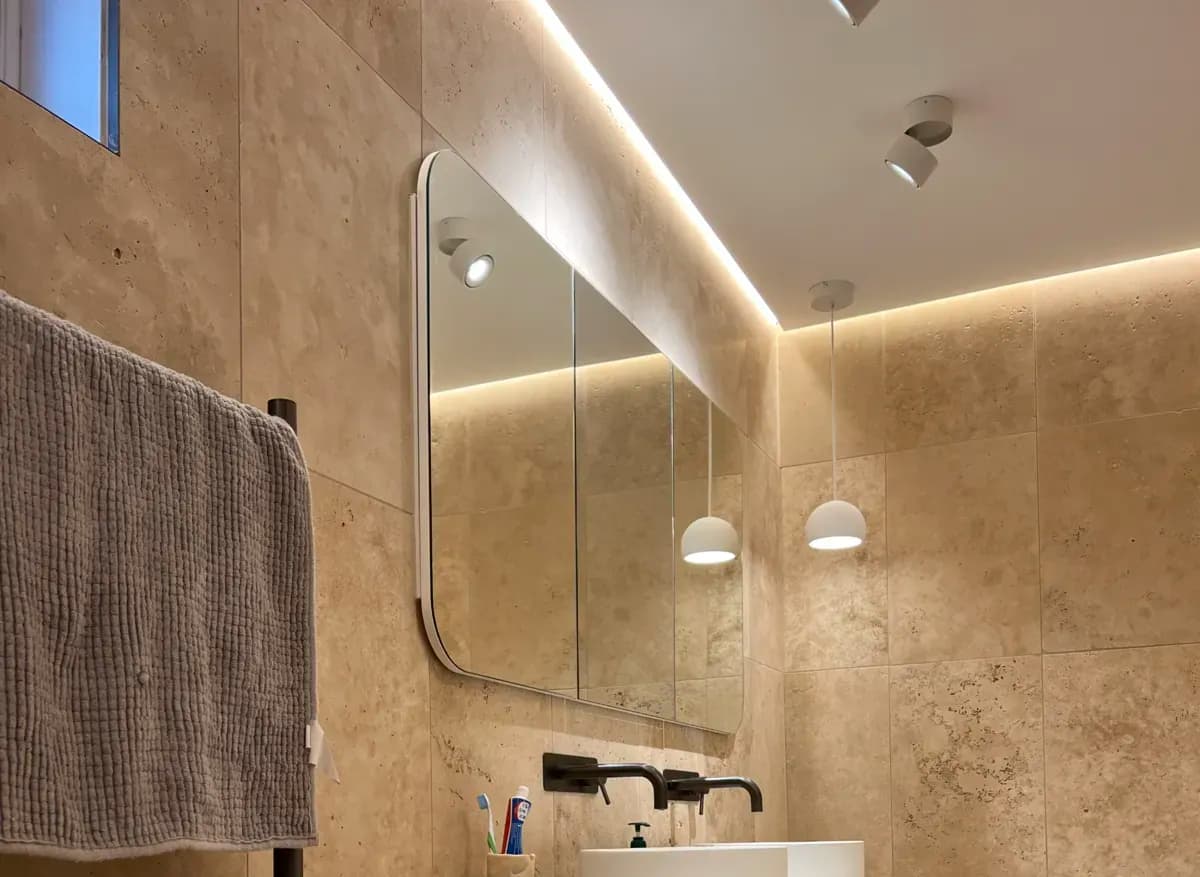
Uplighting on walls (not just overhead) creates dimension and reduces harsh shadows. Wall sconces flanking mirrors or artwork add sophistication.
Edges & Boundaries
Where your open space meets walls, subtle lighting defines the boundary without creating stark transitions. Recessed perimeter lighting or uplighting achieves this.
Colour Temperature Strategy
This is crucial for open-plan success:
- Warm (2700K): Dining, lounge, entertaining areas. Inviting and relaxing
- Neutral (4000K): Kitchen, task areas. Functional and clear
- Mix strategically: Keep zones within 2700K or 4000K for visual cohesion. Mixing 2700K and 5000K creates jarring transitions
The kitchen can be slightly cooler (4000K) without feeling disconnected, because it's functionally distinct. But don't mix 2700K and 5000K in one room—it's visually chaotic.
Practical Layout Tips
1. Recessed Light Spacing
- Space recessed downlights 1.2-1.5m apart
- Position them between functional zones (above benches, not directly over tables)
- Use 4000K in kitchens, 2700K or 3000K elsewhere
2. Pendant Lighting
- Island or dining pendants should be 600-750mm above surfaces
- Space multiple pendants 750-900mm apart
- Ensure they don't create harsh downward shadows
3. Dimmer Zones
- Create separate dimmer circuits for each zone
- Dining area deserves its own dimmer (often the most critical)
- Consider smart dimmers for advanced scheduling and automation
4. Wall Sconces & Perimeter Lighting
- Position sconces 1.6m from the floor
- Space them 2-3m apart for even illumination
- These add sophistication and reduce reliance on overhead lights
Common Open-Plan Lighting Mistakes
Mistake 1: Too Many Downlights
Recessed downlights are tempting but overdone. They create spotlighting effect and harsh shadows. Use fewer; supplement with uplighting and perimeter lighting.
Mistake 2: Ignoring Dimmer Control
Single on/off switches limit flexibility. Dimmers transform spaces for different times and uses.
Mistake 3: Inconsistent Colour Temperature
Mixing warm and cool white throughout creates visual chaos. Choose one for general ambient, use the other for task areas only.
Mistake 4: Forgetting Transition Zones
Hallways and edges between zones become awkward if unlit. Subtle perimeter lighting solves this.
Mistake 5: Not Planning Circuits During Construction
Adding lighting circuits later is expensive and disruptive. Plan electrical layout during design phase, before walls come down.
Implementation Timeline
During Planning (Before Build/Renovation)
- Identify zones and their functions
- Plan circuit layout with your electrician
- Decide dimmer zones
- Choose colour temperatures
During Construction
- Run electrical to all planned locations
- Install proper switches and dimmer infrastructure
- Test circuits before finishes are in place
After Construction
- Install fixtures and bulbs
- Commission lighting (adjust brightness, test dimmers)
- Add finishing touches (artwork uplighting, etc.)
Bringing It Together
Open-plan lighting done well is invisible—the space feels naturally bright, zones feel distinct without being disconnected, and ambience shifts effortlessly between day and evening use.
Here's your lighting design checklist:
✓ Identify zones and their primary functions ✓ Plan task lighting for functional areas (kitchen, bench) ✓ Add ambient lighting through layers (recessed, uplighting, perimeter) ✓ Use warm 2700K for entertaining areas, 4000K for kitchens ✓ Install dimmer controls in every zone ✓ Add accent lighting for visual interest ✓ Ensure transitions between zones are lit smoothly ✓ Plan all electrical circuits during design phase
Design Support
Getting open-plan lighting right requires thoughtful planning. Small decisions during design phase make enormous differences in the finished result.
Power Amp Electrical specialises in modern lighting design for open-plan spaces. We can help you plan circuits, choose fixtures, and design lighting that transforms your open-plan home.
Contact us for a free lighting consultation.